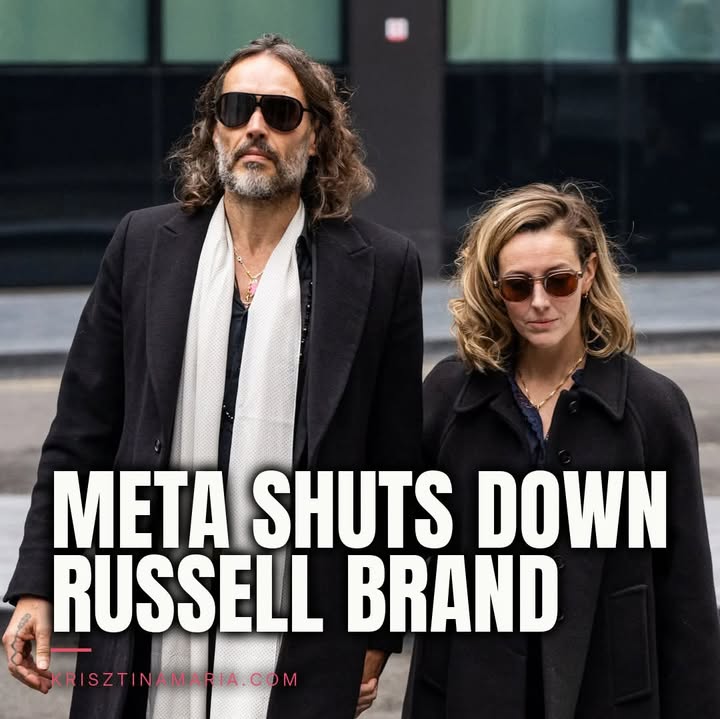
So now they’ve shut down Russell Brand’s Facebook and Instagram accounts.
Just like they also did to the American president. Imagine that. Donald Trump was suspended in 2021 and got his accounts back in 2023.
This isn’t the first time we’ve seen people with power and influence removed from these platforms.
Millions of followers. Years of content. Gone. In Brand’s case, Meta points to its rules following his conviction for r@pe and sexu@l assault.
His account on Elon Musk’s X is still active.
And I have some questions.
The case concerns events between 2004 and 2009. Why did it take so many years? Who knew what back then? Who around him saw something, heard something, and kept quiet while the entertainment industry was still making money off him?
If we’re going to talk about accountability, let’s go all the way.
Brand used to be left-wing and a darling of that crowd. Later, he turned his back on them, embraced Christianity, and began challenging those in power.
That doesn’t prove the case against him was political. But let’s not pretend the excitement over watching someone fall is always free of political interests.
In the r@pe case, the woman testified that she consented to v@ginal s€x but not anal s€x, and that she asked him to stop. The court accepted her account. Consent to one is obviously not consent to the other.
My question is how, 17 years later, you establish what happened with enough certainty to convict someone. Police said there was no forensic evidence or CCTV. They did, however, collect hundreds of witness statements and review extensive documentation. I want to understand which specific evidence supported the conviction.
We should be able to ask that.
I’m tired of the part of MeToo culture that treats you as suspicious the moment you ask about evidence, question the process, or raise concerns about men’s rights in the justice system.
And we need that conversation in my own country, Denmark, too. We’ve had cases under our consent-based r@pe law where men were convicted in a lower court, went to jail and later acquitted on appeal.
Think about what that process do to a person. Being convicted of rape. Facing the loss of your job, your relationships, your entire future. Then being acquitted.
Who picks up the pieces afterward? Who makes sure the acquittal travels as far as the accusation?
Due process applies to men, too. To our sons, too. That should not be controversial.
And then there are Britain’s grooming gangs.
Thousands of children were s€xually exploited. Girls were r@ped, threatened, and moved between towns while the authorities failed them. In Rotherham, many of the known perpetrators were men of Pakistani heritage.
Official inquiries documented that fear of being labeled racist and inflaming community tensions contributed to those failures.
Let that sink in. Adults responsible for protecting children were afraid of a label. Meanwhile, girls suffered abuse year after year.
WHAT IS GOING ON!?
If your fear of being called racist gets in the way of protecting a child from rape, you have no business holding a position responsible for children.
That failure does not make Brand innocent. But it gives us every reason to demand evidence and accountability from authorities instead of offering blind trust.
And now the tech giants have added exclusion from their platforms to his 10 years of prison sentence. By the way. An immigrant from Denmark killed a young swedish man and family father this summer. He got one year in prison.
Why should a criminal conviction also mean years of lawful content and political commentary disappear? Are the rules enforced consistently?
I want a proper answer.
And if you think this post is only about Russell Brand, you’re missing my point. I’m trying to paint a picture here.
It’s about power. Who gets to speak. Who gets shut out. And whether we still have the courage to question the people making those decisions.
Recognizing patterns isn’t the same as proving a conspiracy. But dismissing every uncomfortable question as a “conspiracy theory” is a convenient way to avoid answering it.
Meta is a private company. Its decisions aren’t government orders. But when a handful of companies control access to enormous public conversations, their power deserves scrutiny, too.
I look at what’s happening across the Western world, and I’m seriously concerned about where our systems are headed. Institutions are losing people’s trust. Authorities are failing the people they’re supposed to protect. And disagreement is too often treated as a problem to eliminate.
What is our freedom worth if people only feel free to speak when they fall in line, march in step, and hold the approved opinions?
I’m worried about the anger. The distrust. The distance between us. And what happens if those in charge keep refusing to listen.
I want accountability. Open debate. Institutions that can handle being challenged.
I don’t have to declare Russell Brand innocent to question those in power.
If your principles only apply to people you like, what are they worth?